Braun's Timeless Utility: Less But Better as a System
Braun's golden era under Dieter Rams showed how less but better becomes a system: coordinated objects, rigorous proportion, gentle tactility, and interfaces…
Why Braun still matters for contemporary design
Braun's radios, shavers, and clocks never shouted; they calibrated. Their calm competence is not nostalgia—it's a systemic approach to designing for long-term use. Rams articulated "less but better" as ten principles, yet what made them alive was how they translated into material choice, interaction cadence, and manufacturing discipline. In an era of ambient computing and AI agents, Braun's method offers a template for products that remain understandable, maintainable, and humane.
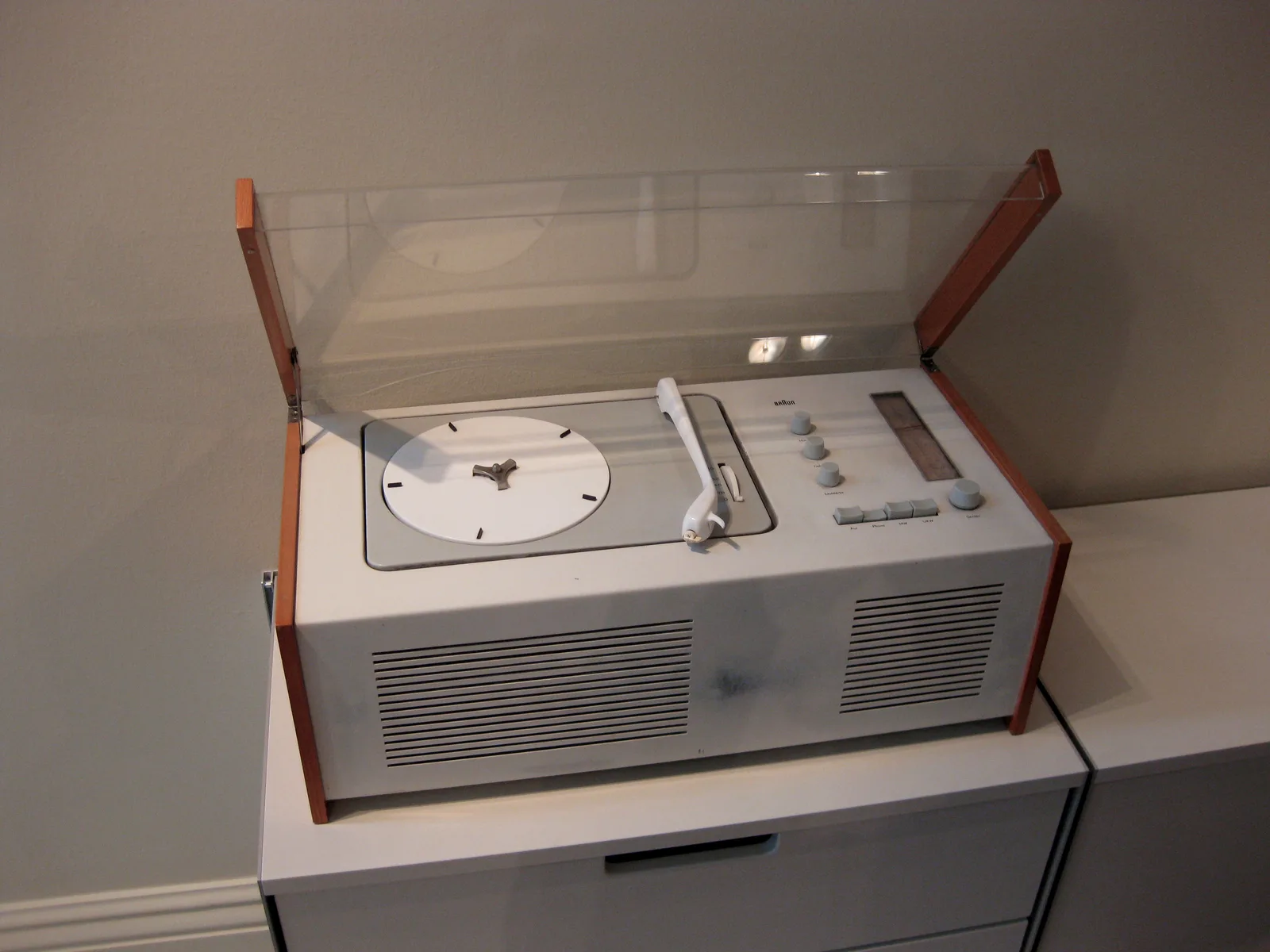
Braun SK 4.1 "Schneewittchensarg" (1956) by Dieter Rams and Hans Gugelot. Photo by With Associates, licensed CC BY-SA 2.0 via Wikimedia Commons.
Less but better as a system, not a slogan
Rams never intended "less but better" to be a minimalism aesthetic; it was an operating model. Its system properties show up when you zoom in:
- Unified geometry: shared radii, grid spacing, and module sizes make products cooperate visually on a shelf or desk.
- Hierarchy by use cadence: high-frequency interactions live front-and-center; infrequent controls recede without disappearing.
- Color as signal, not decoration: neutrals dominate; a single high-contrast accent points to the decisive action.
Simplicity isn't about fewer parts—it's about aligning parts with intent until they feel inevitable.
Material honesty creates trust you can feel
Braun products aged gracefully because the material story was true:
- Enclosures in ABS blends with micro-texture diffuse scratches instead of highlighting them.
- Aluminum dials and switches are brushed, not plated; wear reveals consistency rather than flakes.
- Leather cases, when used, were vegetable-tanned and stitched plainly so patina reads as care, not decay.
Material honesty is a cognitive shortcut. Users intuitively sense when a surface pretends to be something it isn't. Braun's approach keeps attention on interaction rather than on reconciling visual deceit.
Interaction logic shaped by cognition
Consider the T3 pocket radio or the ET66 calculator: both teach through structure.
- Single-task clarity: the form factor reinforces purpose—hand-sized rectangles with clear affordances reduce decision fatigue.
- Progressive disclosure: primary controls (volume, station, numeric keys) occupy prime real estate; secondary functions sit in subtly recessed zones.
- Feedback without drama: tactile detents, gentle clicks, and restrained acoustic feedback confirm actions without hijacking attention.
- Type hierarchy: typography is weight-graded, left-aligned, and consistent across devices, making cross-product learning cumulative.
These decisions anticipate today's UX heuristics: respect working memory, constrain choice architecture, and signal state transitions cleanly.
Manufacturing discipline as design language
Rams collaborated tightly with engineers and toolmakers. The result was aesthetics born from achievable tolerances:
- Split lines coincide with structural ribs, hiding mold parting while strengthening the shell.
- PCB layouts mirrored the enclosure's geometry, minimizing wiring complexity and failure points.
- Serviceability was preserved through clipped or screwed assemblies rather than adhesives, enabling repair culture before it was fashionable.
In a world where sustainability demands repairability, Braun's manufacturing discipline feels freshly relevant.
Translating Braun lessons to digital products
The Braun method is not locked to analog hardware. Its lessons map to interfaces and software systems:
- Visual grids: establish consistent spacing tokens so components snap into rhythm across screens.
- Semantic color: reserve accent hues for primary actions; let neutrals carry the rest.
- Interaction pacing: maintain predictable feedback timing; do not let motion overshadow meaning.
- Documentation as product: just as Braun's internal standards guided hardware, modern design systems need living documentation for teams to reuse patterns faithfully.
When digital products follow these constraints, they inherit Braun's calmness even on luminous surfaces.
Human warmth without ornament
Braun devices manage to feel friendly without resorting to decoration. Rounded corners soften the approach; soft-touch textures invite grip; proportion keeps them approachable. The warmth comes from ergonomics and clarity, not from stylistic veneers. This is instructive for AI-era products: we can build interfaces that feel trustworthy through responsiveness, explainability, and tactile kindness, not through anthropomorphic gimmicks.
Closing: design that can live with you for decades
Braun's discipline shows how aesthetics, engineering, and ethics can reinforce one another. Products become companions when they can be understood, repaired, and integrated into daily rituals without demanding attention. The goal is not to freeze time in mid-century nostalgia; it's to build systems today that age with dignity.
The measure of "better" is whether an object still supports you ten years on—
not whether it dazzles you on day one.